Free guide · Meta ads
My Meta ads campaign strategy.
The structure, budgets and testing system I run on every Meta ads account in 2026. Three campaigns, the break-even maths, my kill and scale rules, a weekly rhythm, and a Claude prompt that builds the plan around your own numbers.
By Mohammad Mansoori12 min read
What's inside
- 01How Meta's ad engine works now, and the four rules that replaced the old playbook
- 02The setup checklist and the two numbers to know before you spend
- 03The three-campaign structure: Test, Scale and Warm
- 04How much to spend, and how to scale without breaking delivery
- 05Building creative concepts that count as genuinely new
- 06When to kill an ad and when to scale it
- 07My weekly rhythm, plus a Claude prompt that builds your plan
01Meta changed. Your strategy should too.
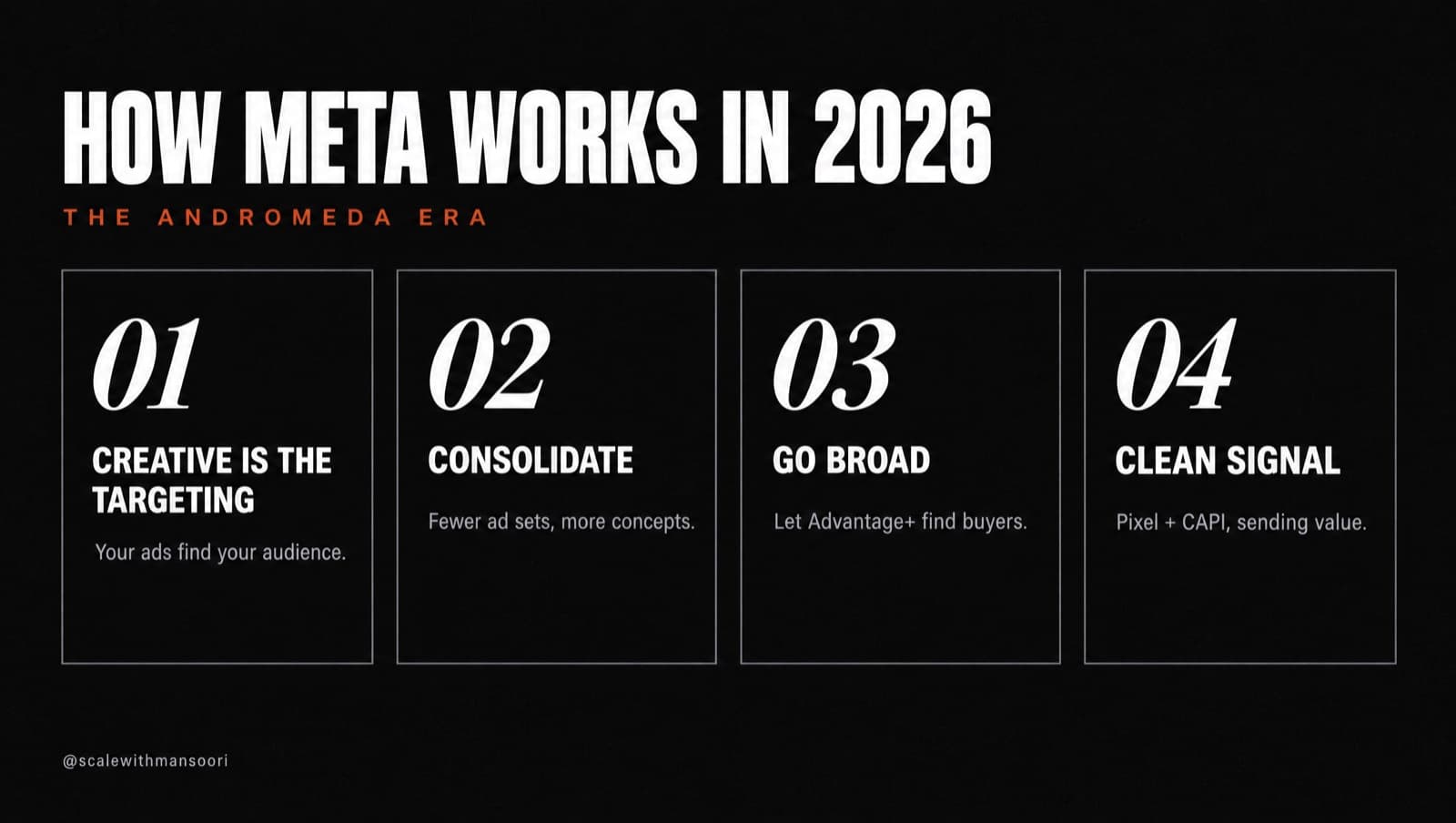
Meta's ad engine, called Andromeda, now reads what is inside your ad to decide who sees it. The old playbook of 20 ad sets with tight interests and one ad each no longer works. These four rules replaced it.
- Creative is the targeting. Different concepts reach different people. Your ads find your audience, not your interest list.
- Consolidate. Use fewer campaigns and ad sets, with more concepts inside them. The system learns faster when the data sits in fewer places.
- Go broad. Let Advantage+ audience find buyers. Use hard limits only where the law or the offer requires them, such as location or minimum age.
- Feed it clean signal. The algorithm optimises for whatever you track. Bad tracking means it finds the wrong people, very efficiently.
02Do this before you spend
- Pixel and Conversions API, both live
Track the event that means money (Purchase, or a qualified Lead) from the browser and the server, with the same event ID so Meta counts it once. Send the value.
- Know your numbers
Average order value, margin after product, shipping and fees, and how many leads become customers. Without these you can't judge an ad.
- A landing page that matches the ad
Same promise, same offer, same visuals. Fast on mobile. One clear next step: buy, book or message.
- A creative bank, not one ad
Start with at least 6 to 10 genuinely different concepts: different angles, people and formats. This is a rule of thumb, not a Meta rule.
- A naming system
Name every campaign, ad set and ad the same way (see section 7), so you can tell which ideas win, not just which file did.
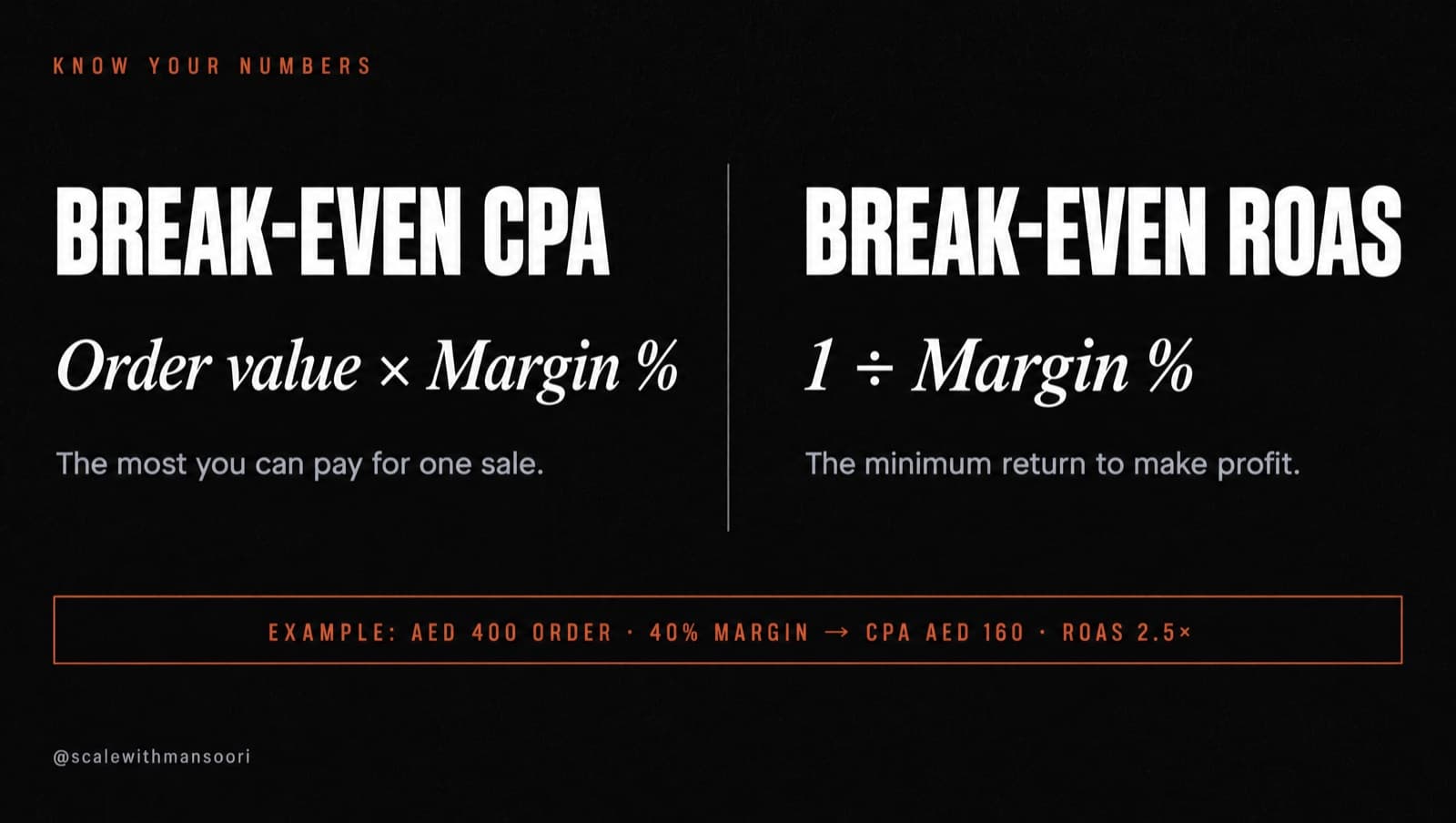
Your two most important numbers
Break-even CPA = Order value × Margin %
The most you can pay for one sale without losing money.
Break-even ROAS = 1 ÷ Margin %
The minimum return before you are profitable.
Example only: an AED 400 order at 40% margin gives a break-even CPA of AED 160 and a break-even ROAS of 2.5×.03Three campaigns. That's it.
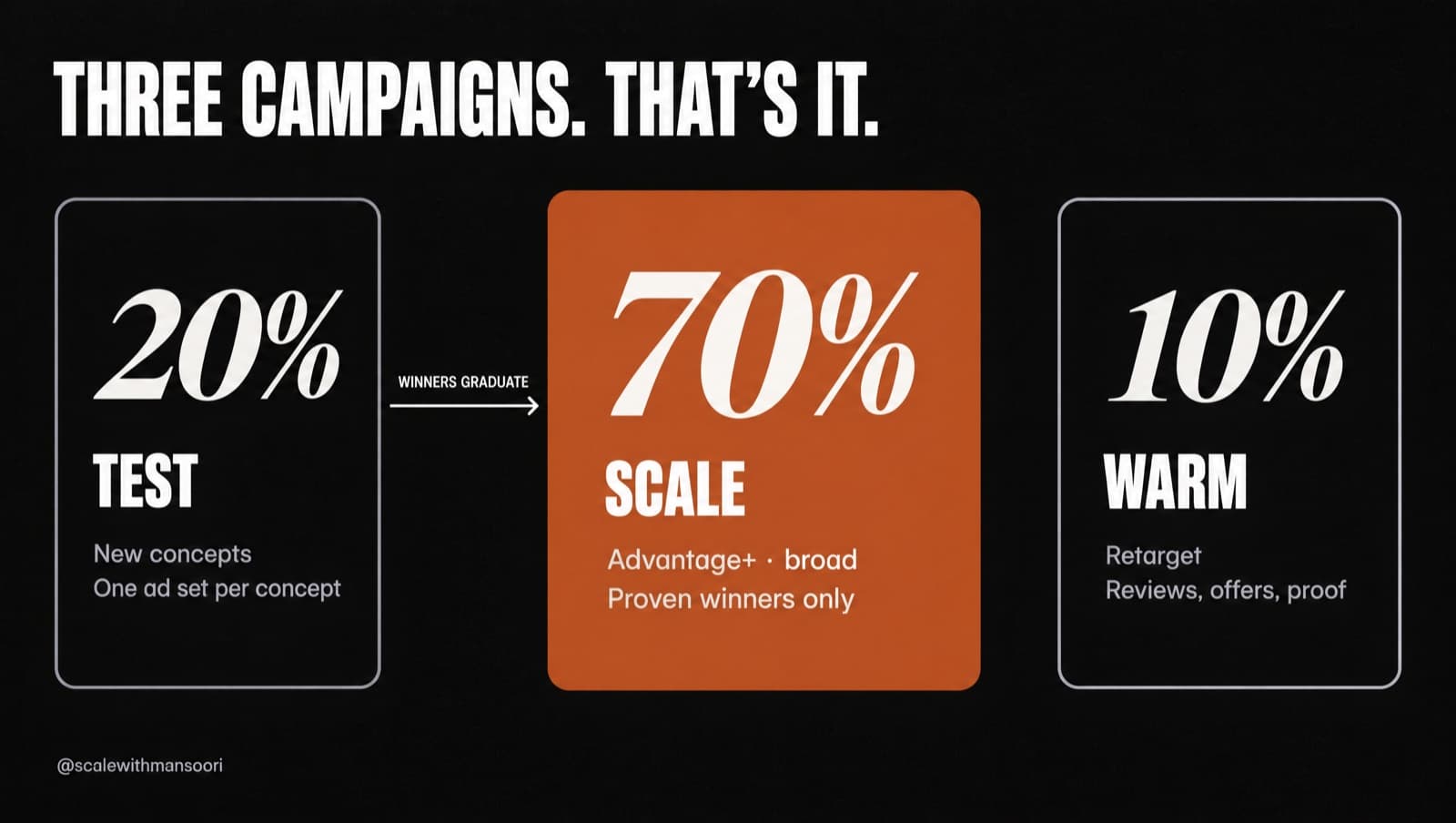
Every account I run starts from this shape. The budget split is a rule of thumb; adjust it once you have data.
| Campaign | Budget | Job | How it's set up |
|---|---|---|---|
| Test | 20% | Find new winning ideas | One ad set per concept, 2 to 4 ads in each (same idea, different hooks or formats). Broad audience, same optimisation event as Scale. Winners graduate to Scale; losers get killed. |
| Scale | 70% | Spend most of the money on proven ads | One Advantage+ sales (or leads) campaign, broad, campaign budget on. Only ads that beat your break-even CPA in Test. Keep 10 to 15 live concepts so the system has choices. |
| Warm | 10% | Convert people who already know you | Site visitors, engagers, video viewers, abandoned carts. Proof-heavy ads: reviews, FAQs, offers, guarantees. Optional: inside Advantage+ you can cap spend on existing customers instead. |
Selling to leads (services, real estate, clinics)? Use the same shape. Optimise for the lead event that matters most, ideally a qualified lead you send back to Meta, not just any form fill.
04How much to spend
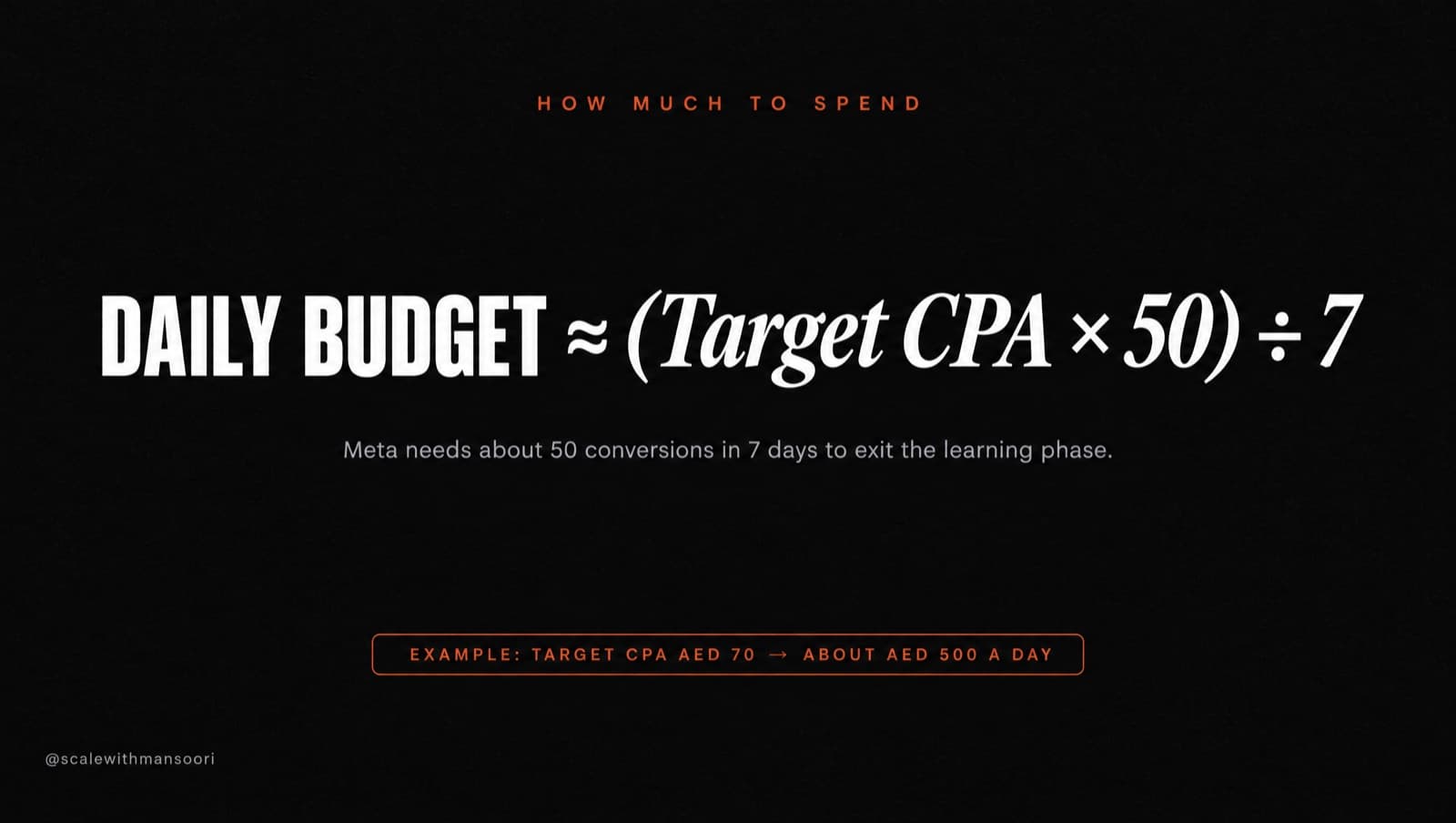
Meta says an ad set needs about 50 optimisation events in 7 days to leave the learning phase. Work the budget backwards from that.
Minimum daily budget per ad set
Daily budget ≈ (Target CPA × 50) ÷ 7
Example only: a target CPA of AED 70 needs about AED 500 a day.If you can't afford that
- Put everything into one ad set so the events aren't split up.
- Optimise for an earlier event that happens more often (Add to cart, Lead) until you have volume.
- Test fewer concepts at once, but test them properly.
How to scale
- Vertical: raise the budget on a winner by about 20% every 2 to 3 days (rule of thumb), so delivery stays stable.
- Horizontal: add more winning concepts to the Scale campaign.
- Don't touch an ad set every day. Every big edit can restart learning.
05The creative does the work
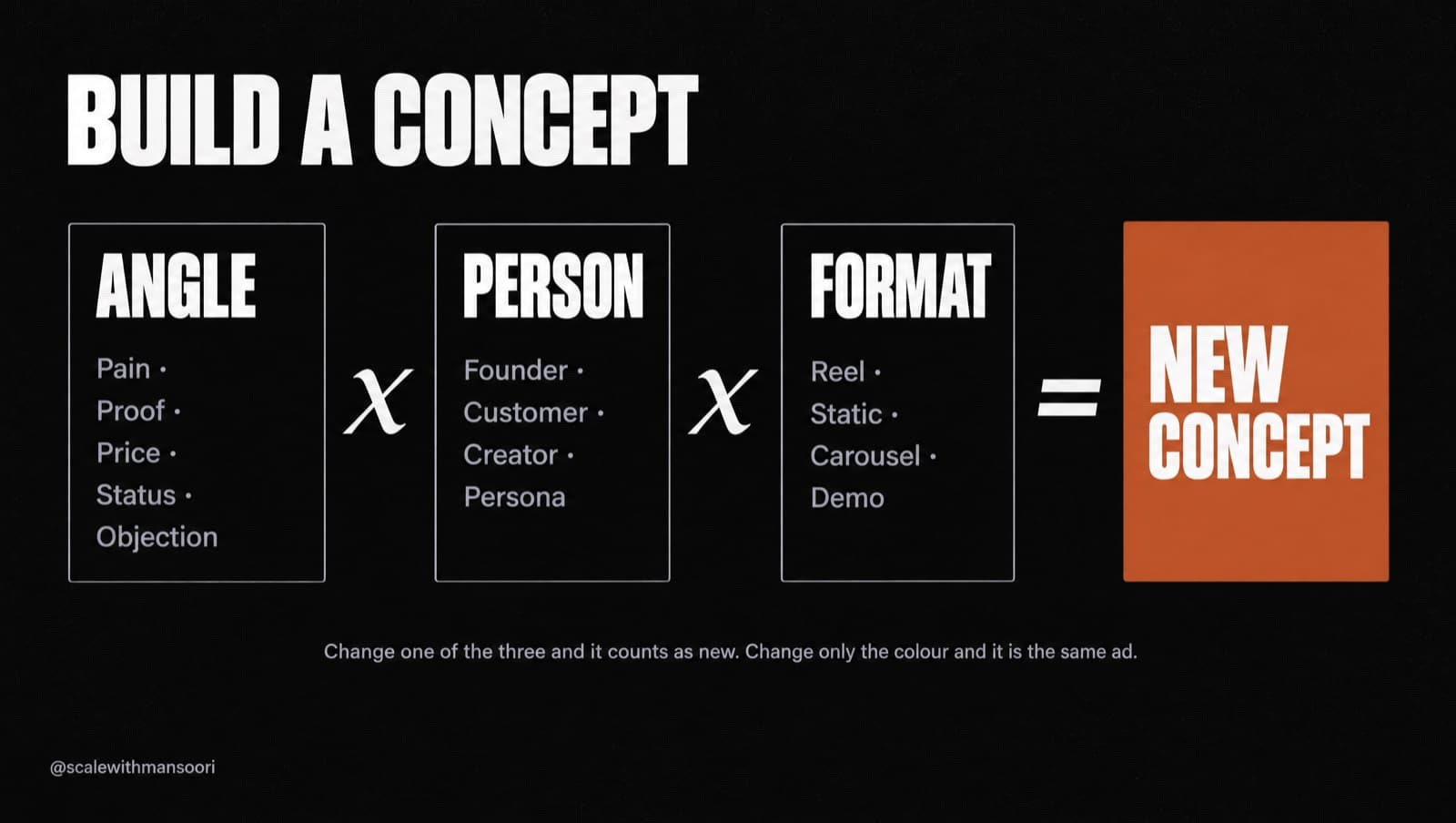
Build each concept from three choices. Change at least one of them and it counts as a new concept. Change only the colour and it is the same ad.
| Angle (why buy) | Person (who) | Format (how) |
|---|---|---|
| Pain: the problem it fixes | Founder or owner | Talking-head Reel |
| Proof: reviews, results, numbers | Customer or UGC creator | Static image |
| Price, offer or value | Expert or partner creator | Carousel |
| Status or identity | No person: product hero shot | Demo or before-and-after |
| Objection: “too expensive”, “will it work for me” | A specific persona (age, job, city) | Image-to-video (Advantage+) |
Hooks: the first 3 seconds
Lead with the payoff. Use a value hook (“the 3 settings I change first”), a statement of intent (“stop doing X”) or a question. Brief at least two hook types per concept.
Build it to work on mute
Burn in captions. Show the product early. Design vertical 9:16 first, then 4:5. Keep text away from the edges where Instagram's buttons sit.
06When to kill, when to scale
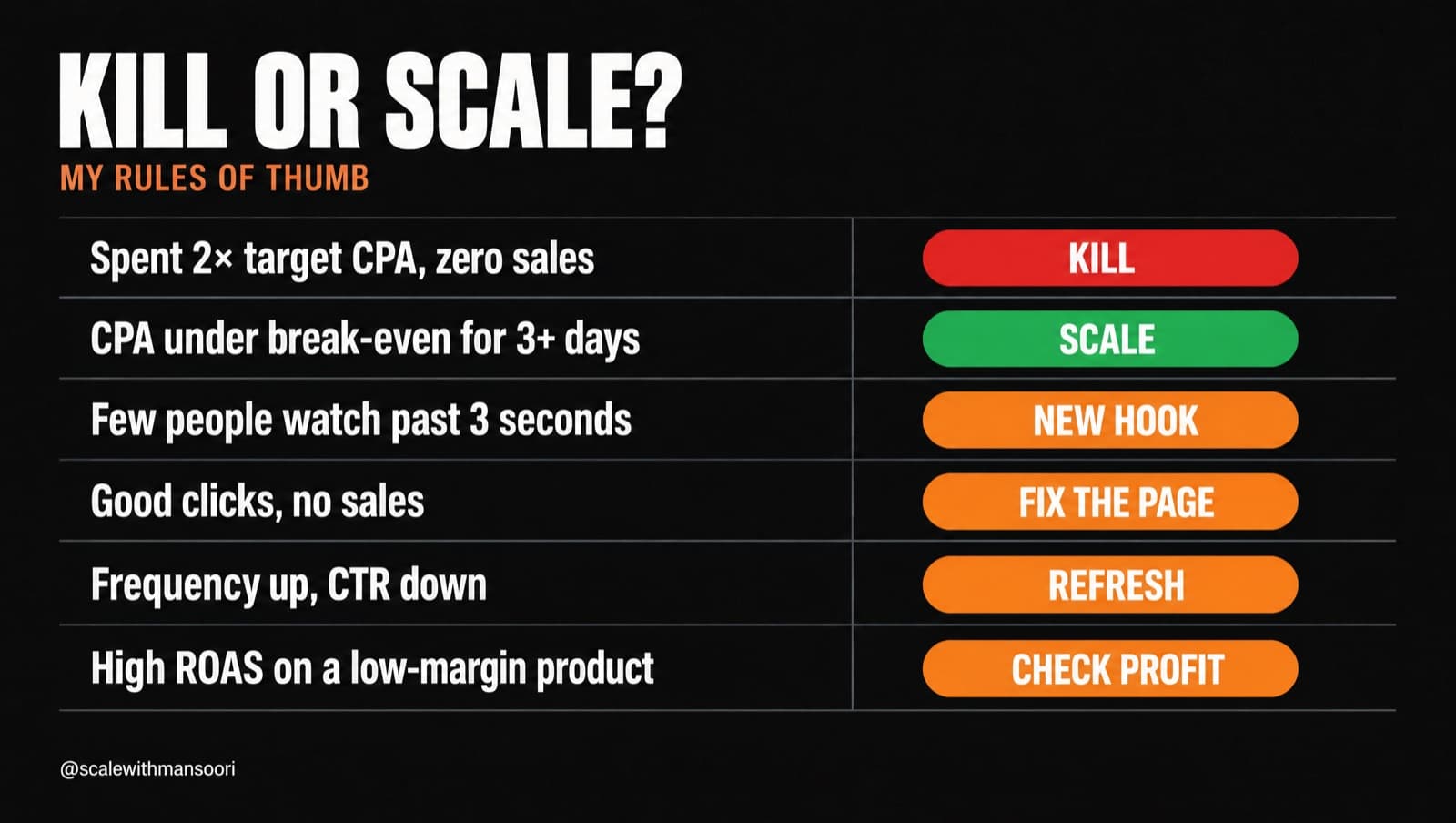
These are my rules of thumb. Write yours down before you launch, so you decide with numbers, not feelings.
| What you see | Decision | Why |
|---|---|---|
| Spent 2× target CPA with zero conversions | Kill | It had enough data to fail. Stop paying for it. |
| CPA below break-even for 3+ days | Scale | Graduate it into the Scale campaign. |
| Low hook rate (few people watch past 3 seconds) | New hook | The idea may be fine. The opening isn't. |
| Good clicks, no sales | Fix the page | The ad works. The landing page or offer doesn't. |
| Frequency rising, CTR falling | Refresh | The audience is tired. Add new concepts; don't raise the budget. |
| Great ROAS, but on your lowest-margin product | Check profit | Judge by profit, not ROAS. |
The four numbers I check first
- Hook rate: 3-second video views ÷ impressions.
- CTR (link): are people clicking?
- CPA: compared with your break-even CPA.
- Frequency: how often the same people see the ad.
07The weekly rhythm
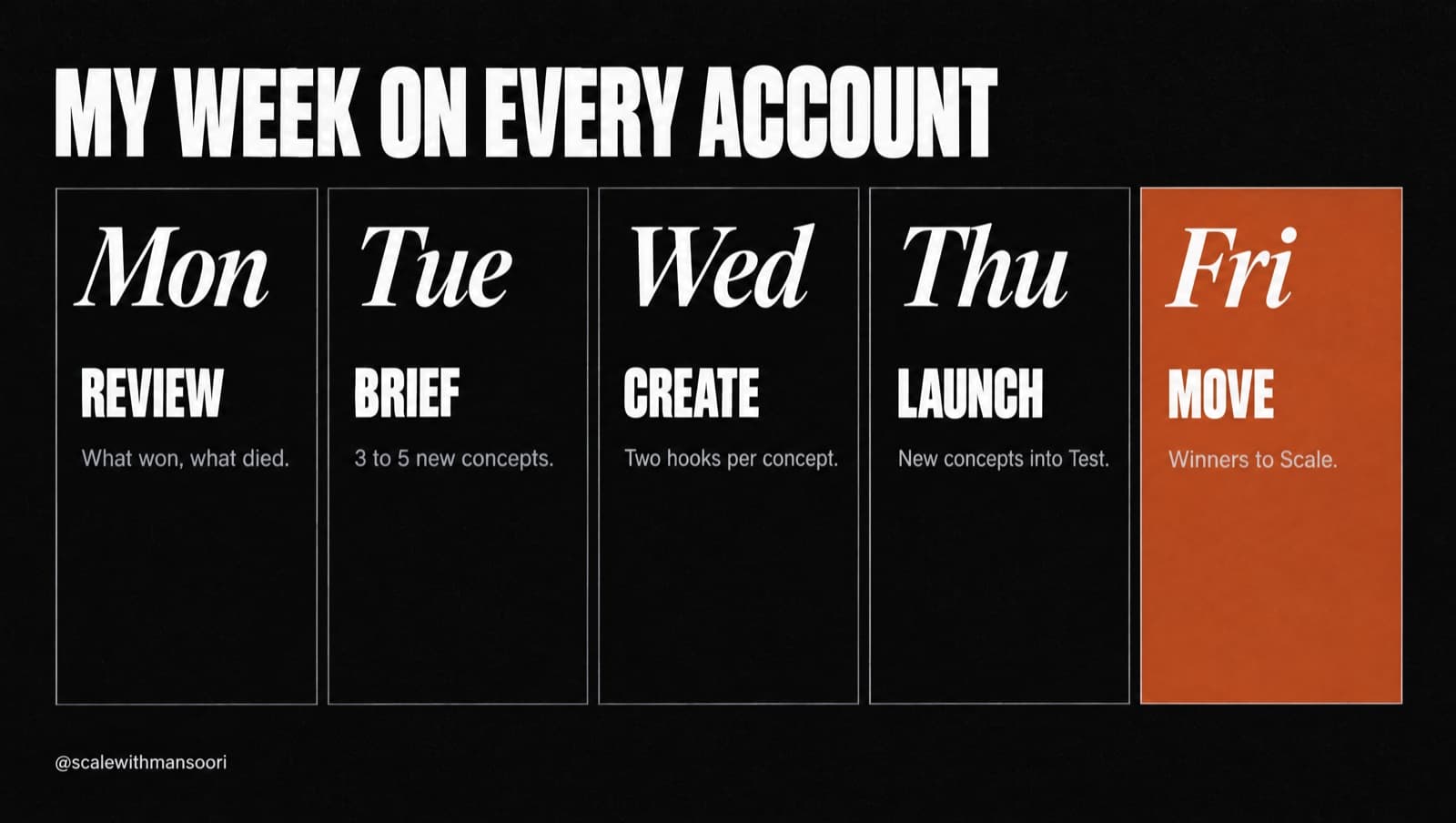
Consistency beats genius. This routine keeps fresh creative going in and bad spend going out.
| Day | Task | What I do |
|---|---|---|
| Monday | Review | Last 7 days: what won, what died, what's tired. Profit first, then CPA. |
| Tuesday | Brief | 3 to 5 new concepts based on what won, each with a new angle, person or format. |
| Wednesday | Create | Shoot or generate. Two hooks per concept. Captions on. |
| Thursday | Launch | New concepts go into Test. No other big edits that day. |
| Friday | Move | Graduate winners to Scale. Kill by the rules. Adjust budgets. |
- Daily, 10 minutes: check that spend is pacing, nothing is rejected, the pixel is firing and no ad is burning money with zero results. No big changes.
- Monthly, 1 hour: look at the age, placement and region breakdowns, rebuild the creative bank, and recheck your break-even numbers if prices or costs changed.
Naming convention
| Level | Example |
|---|---|
| Campaign | Scale_Sales_Broad_2026-11 |
| Ad set | Test_C07_ProofReviews |
| Ad | C07_Proof_UGC-Sara_Reel_HookQuestion_v2 |
08Let Claude build your plan
Paste this into Claude, with the Meta Ads connector switched on or your Ads Manager export attached, and replace the parts in brackets. Not connected yet? The ten-minute setup guide shows you how.
You're my senior Meta ads strategist. Build my campaign plan using this structure: Test (20%), Scale (70%), Warm (10%).

MY BUSINESS
Offer: [product + price] · Margin: [%] · Market: [city/country]
Goal: [purchases / qualified leads] · Monthly budget: [amount]

DO THIS
1. Calculate my break-even CPA and ROAS.
2. Tell me the minimum daily budget per ad set (target CPA × 50 ÷ 7) and how many ad sets my budget can actually support.
3. Give me 8 concepts (angle × person × format), each with 2 hooks.
4. Lay out the 3 campaigns: settings, budgets, which ads go where.
5. Write my kill and scale rules using my numbers.

Use tables. Flag anything you're unsure about. Don't invent results.
Work with me
Want me to build yours?
Use this guide to set up your account. If you'd rather I look at it myself, message me the word AUDIT and I'll show you where the money is leaking before you pay anything.
More free resources
Free Claude Skills: Lead Finder and Proposal Builder
Two Claude skills you can download and install in a minute. Lead Finder builds a verified lead list with a personal email for each lead. Proposal Builder researches a client and builds the deck as a PDF.
My Ad Script Template
How I script Meta ads since Andromeda: one ad per persona, in three parts (persona, offer, CTA). Fill-in template, a worked example, and a Claude prompt that writes a script for each of your personas.

How to Connect Claude to Meta Ads
A ten-minute setup for Meta's official Ads connector in Claude, the two places to set guardrails, and the research prompt I run on every account.